These are the days that make me want to build a cocoon around our house and just stay inside...maybe forever...at least until my kids are adults.
I look at Owen and he is fine...more than fine, happy, sweet, smart, playful...good. Great. He is great. We are lucky because he is so great.
And yet, whenever we have to let him out into the world without us (say, to fish camp this this week), he's not so great. He gets mad and he gets frustrated and people don't understand why he is so loud. And I hate other people then. I hate that he is a problem for them. I hate that they aren't able to help him. I hate that he feels scared and overwhelmed and that I can't always be there.
I hate that I can't always be there.
But maybe what I hate more is what it does to Aidan. Because Owen feels bad for a bit, but when the fit is over, he's pretty much over it. He'll tell you he had a great day. He can be happy as quickly as he can be mad. And he doesn't really care what people think about that.
But Aidan...Aidan cares what people think. He is acutely aware of the eyes that are on him when his brother is screaming about not being able to tie a knot or whatever the the meltdown is about that day. He wants to crawl into a hole and it's not fair.
It's been a bad week at fish camp. I can't tell if Owen has actually been having a harder time at this camp, or if these instructors have a lower threshold, because if it had been this bad at other camps (if it had been reported to me as being this bad), I probably wouldn't have sent him to camp this week...or possibly ever.
What kills me is that he likes camp. The fits don't bother him nearly as much as they bother everyone else. When I tell him maybe he should just stay home tomorrow (should he? I have no idea), he gets upset about what he'll miss. And then I've got Aidan agreeing with me because all he wants is to do is go to camp and not be the brother of that weird kid. And then I cry and Aidan cries and even Owen, with his supposedly limited ability to empathize, comes and sits next to me and says he'll try really hard. And you see, I'm back to hating everyone outside of my house.
Is he getting worse? That's what I keep wondering. Am I being unfair or unrealistic by thinking he can cope in these "typical" camps for "typical" kids? I check all the boxes and answer all the questions and hope for the best and this time it's just especially bad. Maybe this is the exception and not the rule...but I can't help feeling like maybe I've just been in denial about the way it's been going at all of these other camps. Maybe they just didn't have the heart to tell me...or the energy.
Next year I'll send them to separate camps. It won't solve the issues with Owen, but at least it will allow Aidan to be carefree.
Or maybe camp is overrated. Maybe we'll just drop off the grid entirely until they emerge as adults whose eccentricities are valued because they're so brilliant...I have to tell you that I like that scenario a lot better than this one. Today, I do, anyway. But this is one of those days...and these days are fucking hard.
Showing posts with label Asperger's syndrome. Show all posts
Showing posts with label Asperger's syndrome. Show all posts
Wednesday, August 24, 2011


Thursday, April 14, 2011
Enormity
Great day in the autism department. We met with the child psychologist and she was smart, kind, and most importantly, well-educated about autism. She honed in on the emotional regulation issue immediately. But what I liked the most was how much time she spent on his exceptional and amazing qualities. (and that she really listened to him)
For the first time I realized that the reason I've discounted a lot of what we've heard from the special education teachers at his school is that they never seem to view him as a whole person. It always feels like he's a set of issues that need to be overcome. That they're just doing what they can to get him back into the herd.
But the woman we met today - let's call her Dr. Wonderful - saw him as a whole person. A charming, smart, articulate little boy who gets overwhelmed and doesn't know how to express himself. A person that's coping the best way he knows how. She shrunk his autism down to size, rather than letting it take up the whole frame, as it so often likes to do.
The plan is to keep seeing Dr. Wonderful to work on helping him regulate his emotions - which, she explained, basically comes down to "learning to tell people what you need, so that they can give it to you." (couldn't we all benefit from such a lesson?) If he can learn how to do this, we should be able to reduce, if not eliminate, the meltdowns that disrupt his everyday activities. (Insert huge sigh of relief)
That's what she's doing for Owen. But what she did for me today was confirm what I've long suspected, but still allow myself to doubt sometimes: He's going to be okay.
Sure, school will be a little harder for him sometimes. Conversations might always take more effort for him. But in the grand scheme of things, he's fine.
I know it seems small, but it's not. It's enormous.
For the first time I realized that the reason I've discounted a lot of what we've heard from the special education teachers at his school is that they never seem to view him as a whole person. It always feels like he's a set of issues that need to be overcome. That they're just doing what they can to get him back into the herd.
But the woman we met today - let's call her Dr. Wonderful - saw him as a whole person. A charming, smart, articulate little boy who gets overwhelmed and doesn't know how to express himself. A person that's coping the best way he knows how. She shrunk his autism down to size, rather than letting it take up the whole frame, as it so often likes to do.
The plan is to keep seeing Dr. Wonderful to work on helping him regulate his emotions - which, she explained, basically comes down to "learning to tell people what you need, so that they can give it to you." (couldn't we all benefit from such a lesson?) If he can learn how to do this, we should be able to reduce, if not eliminate, the meltdowns that disrupt his everyday activities. (Insert huge sigh of relief)
That's what she's doing for Owen. But what she did for me today was confirm what I've long suspected, but still allow myself to doubt sometimes: He's going to be okay.
Sure, school will be a little harder for him sometimes. Conversations might always take more effort for him. But in the grand scheme of things, he's fine.
I know it seems small, but it's not. It's enormous.
Saturday, April 2, 2011
A Different Kind of Different
I read the introduction of "Be Different" and I'm really excited. I can't wait to give it to Owen to read...the only thing nagging at me is how to explain Asperger's syndrome vs. autism (because John Elder Robison has Asperger's and writes specifically about Asperger's.) The simplest explanation is that Asperger's is the highest functioning end of the autism spectrum.
What trips me up is that Owen seems to be at the highest functioning end of the spectrum and yet he's been diagnosed with the broadest term "autism." This is supposedly due to the fact that when he was little he displayed echolalia, the condition common among kids with ASD where they repeat what you say rather than actually coming up with their own words (this only lasted until he was maybe 3). It's considered a speech disorder and, to my best understanding, kids with Asperger's don't have speech disorders, which means Owen gets put in the autism category.
According to Wikipedia: "The amount of overlap between high-functioning autism (HFA) and Asperger syndrome is disputed. Some researchers argue that the two are distinct diagnostic entities, others argue that they are indistinguishable."
The science in this area just still isn't altogether scientific...and the process of diagnosing autism is still very subjective. It's the combination of observation (usually by a doctor who has only known the child for a short time) and information provided by the parents. I can tell you that I did not enjoy the pressure of trying to accurately remember every milestone he did or did not reach from birth to age 3...especially considering I had twins.
Does it really matter whether Owen technically has autism or Asperger's? In the grand scheme of things, probably not - I'm well aware that the label has nothing to do with who he is as a person. But it matters to me in terms of helping him understand what exactly is so different about is brain. And, honestly, telling people your kid has Asperger's tends to be different than telling them he has autism (I've done both) - people tend to associate Asperger's with socially awkward geniuses, which is far less scary to the general public than "autism" which, unfortunately, a lot of people still don't understand.
I can't really blame people for being confused about autism since the spectrum is so broad. There's still that old picture of the child who can't speak and bangs his head against the wall or has violent outburts - and this is reality for some kids at the far end of the spectrum - but there are a million variations in between that picture and, say, Albert Einstein (whom many now think had Asperger's). There are all kinds of developmental delays, communication challenges and, most commonly, social issues that affect people with ASD.
There's no blanket approach to kids with autism because every single one is going to have his or her own quirks, issues, and gifts. Unfortunately, our world likes blanket approaches. Our public school system is built on a blanket approach to education. And corporate America is still pretty much built on a blanket approach to success. But with 1 in every 110 people in America now diagnosed with some form of autism, we're going to have to find another way.
Sorry, I went off on a tangent there. We were talking about Owen. My sweet, brilliant, funny little Owen. Whose traits I identify much more closely with Asperger's than classic autism...I don't know if there's a good solution to that dilemma. I'm guessing that as he gets older, it will become clearer and he'll be able to decide for himself what he wants to tell people. In the meantime, I can just keep being honest with him.
Saturday, February 26, 2011
Secret Autism?
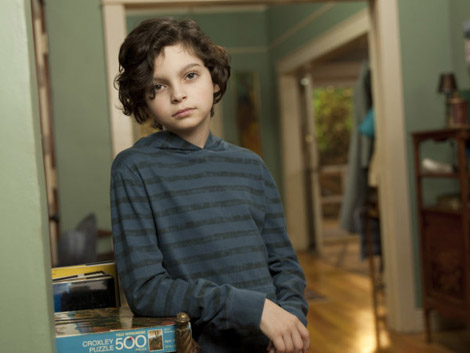 I'm a few days behind on this, but I finally caught up on "Parenthood" and had to ask: Is the storyline of keeping Max's Asperger's diagnosis a secret from him rooted in any type of reality?
 Look, I know that it's TV and I forgive the fact that nearly every family drama gets neatly wrapped up in a bow after two episodes (mostly because I like Lauren Graham and her kids so much), but the autism/Asperger's storyline has bugged me from the start.
I have no issue with the portrayal of Max. In fact, I think that the actor who plays him does an amazing job - so amazing, that I had to Google him to make sure he doesn't really have autism. I see bits of Owen in every one of Max's monologues and meltdowns. (Owen even has that shirt Max is wearing.)
But this idea that Max is 8 years old, goes to a school for special needs kids, has a full-time developmental aide and doesn't know that he has Asperger's...I don't get it. It doesn't make logical or even TV sense to me. Do people do that to their kids? And are there 8 year-old Aspies who haven't yet started to ask questions? It's so illogical to me that I'm wondering whether it could possibly be based on an experience that one of the producers has had, because otherwise I can't even figure out why they'd make it up.
I don't want people who aren't familiar with autism to think that it's something we hide from our kids until they accidentally overhear us fighting about it one day.
We told Owen he had autism when he was four or five. I don't know when exactly, because it doesn't stand out as a monumental occasion. We didn't stay up all night explaining it, as it appears they're going to do on "Parenthood" next week. After more than a year of seeing therapists and then starting a more intensive preschool program than his twin brother, it was obvious to him that he was different somehow.
We'd always said, "You just need extra help with some things," and then -- maybe it was around his re-evaluation, where we'd hoped to determine whether he actually had classic autism or if he was in the Asperger's category (he meets the criteria for autism, but seems more functional thana lot of kids I've seen with Asperger's, but that's another topic) -- one day we said, "The reason you need extra help sometimes is that you have autism." We've always said that it just means his brain works a little bit differently. That he's just as smart as Aidan, but he just sometimes has trouble with things that Aidan and other kids don't.
Owen is fine with it. Aidan is fine with it. We talk about it freely, particularly when Owen is having a meltdown. It helps Owen understand why he struggles and it helps Aidan understand why we don't always treat his brother's fits the same as his own.
Actually, Owen is more than fine with it. Sometimes he uses it to elevate himself to special status in comparison with his brother ("Well, I'm the one with autism.") and just a few months ago, he came home from school and announced that he had started an Autism Club with a girl in his class who has Asperger's. I think that's pretty awesome.
I can't imagine why parents would choose to treat it as something to be hidden. A secret that even the person afflicted with it shouldn't know...I just don't get it, and I'm curious if anyone out there can explain it to me? Does this really happen? And do people actually think it's a good idea?
Monday, April 12, 2010
In Praise of Smart, Geeky Kids
Dr. Grandin, please find a way to turn your philosophy into an actual school my Owen can attend.
(Thank you, Jill)
Friday, April 2, 2010
Spread some knowledge, spread some love
Happy World Autism Awareness Day!
I’ve written about autism. Many. Many. Many times. It’s part of my everyday life.
With 1 in every 110 children now being diagnosed with an autism spectrum disorder, there’s a good chance that autism is part of your life, too – or that you at least know someone (me?) who is affected.
So how does one celebrate such a day? (Or an entire month, for that matter, since April is Autism Awareness Month.)
Well, if you’ve got a kid on the spectrum, the first thing to do is hug him (or her, but it’s four times more likely to be a him) and remind yourself how lucky you are to have this little (or big) person in your life. (This same process can be followed with typical kids even though it’s not Neurotypical Awareness Day.)
Next, you might want to consider donating to Autism Speaks or another autism-related cause. Your money could go to the brilliant scientists who are going to figure out why our kids’ brains are different and then find a cure. Or, maybe it will go toward making it illegal for insurance companies to discriminate against our kids. There are lots of other worthy efforts around autism that also need funding, but those are the two biggies at the moment.
And, my final recommendation on celebrating World Autism Awareness Day and Autism Awareness Month: Educate yourself and others. Understanding is the key to progress here.
I’ve written about autism. Many. Many. Many times. It’s part of my everyday life.
With 1 in every 110 children now being diagnosed with an autism spectrum disorder, there’s a good chance that autism is part of your life, too – or that you at least know someone (me?) who is affected.
So how does one celebrate such a day? (Or an entire month, for that matter, since April is Autism Awareness Month.)
Well, if you’ve got a kid on the spectrum, the first thing to do is hug him (or her, but it’s four times more likely to be a him) and remind yourself how lucky you are to have this little (or big) person in your life. (This same process can be followed with typical kids even though it’s not Neurotypical Awareness Day.)
Next, you might want to consider donating to Autism Speaks or another autism-related cause. Your money could go to the brilliant scientists who are going to figure out why our kids’ brains are different and then find a cure. Or, maybe it will go toward making it illegal for insurance companies to discriminate against our kids. There are lots of other worthy efforts around autism that also need funding, but those are the two biggies at the moment.
And, my final recommendation on celebrating World Autism Awareness Day and Autism Awareness Month: Educate yourself and others. Understanding is the key to progress here.
Acceptance is a good start - all of our kids (and we, as their parents) deserve to be treated fairly. But the importance of cultivating understanding goes deeper than acceptance. If everyone understood the disorder better, we could have more support for people on the spectrum, more people working on treatments, and more people funding the research that will ultimately lead to its cause and its cure. It can start with you.
• More children will be diagnosed with autism this year than with AIDS, diabetes and cancer combined.
• No one knows what causes autism and there is no proven link between autism and vaccines.
• Children with autism have trouble relating to other people. This can mean everything from being socially awkward to being unable to speak.
• Even though there is no cure for autism, early intervention with individualized therapies has been proven to treat the symptoms of the disorder, helping kids gain many of the skills they need to learn and become functional adults. Some parents would go so far as to say that their children have actually "recovered" from the disorder. For the majority of people with autism, however, it's something they will deal with their entire lives.
Just in case you need a cheat sheet, here are a few key points you might want to share:
• Autism is a neurological disorder that affects every person differently. It’s called a spectrum disorder because of the wide variance in symptoms and severity among affected individuals.
• Autism is a neurological disorder that affects every person differently. It’s called a spectrum disorder because of the wide variance in symptoms and severity among affected individuals.
• More children will be diagnosed with autism this year than with AIDS, diabetes and cancer combined.
• No one knows what causes autism and there is no proven link between autism and vaccines.
• Children with autism have trouble relating to other people. This can mean everything from being socially awkward to being unable to speak.
• Even though there is no cure for autism, early intervention with individualized therapies has been proven to treat the symptoms of the disorder, helping kids gain many of the skills they need to learn and become functional adults. Some parents would go so far as to say that their children have actually "recovered" from the disorder. For the majority of people with autism, however, it's something they will deal with their entire lives.
That's really just the beginning, but I hope that it gets you (or someone you know) thinking and interested in learning more. In addition to the Autism Speaks site, which has tons of good information, I recommend the book " Ten Things Every Child With Autism Wishes You Knew." I have other recommendations too, but I'll save some of them to last me through the month.
Tuesday, March 9, 2010
In the 'Hood
I'm behind on this, but still wanted to mention it: Parenthood, the show. Did you watch? I DVR'd it (R.I.P. Tivo) and finally watched in on Sunday. I like it.
I know it's contrived (aren't all TV shows contrived?), I know every character is some kind of vague caricature of a stereotype of some kind or another. But...I like it. I think it has potential.
But what I wanted to note specifically was the Asperger's/autism storyline (of course) because even though it wasn't perfect, the scene where the mom tells the dad that their son was diagnosed...it made me cry.
They were able to hit on the rawness of that moment...the emotion, the confusion that I think most people have when they find out. And that struggle between the parents...her trying to make him understand that she needs him to believe it, him saying that he won't let his son be put in special ed...it was familiar. It was hard to watch even a TV couple going through it.
I was impressed that they were able to hit that nerve in me, as I'm the person who could never watch the episodes on ER when they were in the NICU because of the gross oversimplifications and inaccuracies. But with this, so far, I'm in...maybe it's the whole Lauren Graham/Craig T. Nelson combo, not sure.
Yes, so the whole "It's my team" business at the end was fairly unbelievable, but I'm forgiving them that on the promise that they will ultimately help more people understand the sometimes quieter, more subtle, but no less gut-wrenching, struggles of having a child with autism. Don't let me down, NBC.
Monday, June 22, 2009
Panic at the nerd camp
The boys started science nerd camp today! To see all these little brainiacs arrive, carrying armloads of broken electronics, which they had lovingly stockpiled over the past year so that they would have more parts from which to realize the inventions of their little imaginations, filled my heart with joy.
Plus, I knew my socially awkward children wouldn't have to worry about bullies.
But, as with every new camp or class or lesson, came the dreaded question of "Do I tell them or not tell them?" about Owen's diagnosis. I've mentioned this question before, but it still remains an area of uncertainty for me. Take today...
We arrived at said nerd camp and met the boys' group leader, a maybe 18-year-old named Eddie. In this case, I'd already disclosed Owen's diagnosis on the many forms we were required to fill out in order to register him for camp, so I said to Eddie, "Maybe you already know this, but Owen has high-functioning autism." Honestly, I figured that in a science camp for gifted and talented kids, autism (or at least Asperger's) would be a familiar concept.
The look of panic on Eddie's face suggested otherwise. Shit, I thought. Shouldn't have said anything.
"He'll be fine," I continued. "All it means is that he gets spacey and might need some extra reminders - especially during lunch...I don't want him to run out of time and not eat." (This actually happened at a different camp last summer.)
The color seemed to be draining out of Eddie's face. "He'll be fine," I repeated. "If he's not fine, you can call me," I offered, trying to make him feel better.
Well, apparently as I kissed the boys goodbye, Eddie had time to gather his thoughts, because on my way out, he came up to say, "I'll make sure he eats." Ok, good. Maybe next time I will just say he gets distracted during meal time and keep the autism out of it.
It's not that I don't want people to know or that I'm trying to "pass him off" as typical, it's that I don't want people to freak out. Nothing about Owen requires any freaking out.
And so I'm still left unsure about whether it's really worth it to tell people. Could a scenario arise in which knowing Owen has autism would help a person who clearly knows nothing about autism, help Owen? Or am I just setting him up to be treated differently unnecessarily?
I don't know the answer to those questions. What I do know that both boys had a fabulous time at camp. I did, however, find a barely-eaten sandwich in the lunch box this afternoon...only this sandwich belonged to Aidan.
Thursday, April 16, 2009
First, Do No Harm
Just as I thought I was losing steam on my autism blogs, along comes the latest controversy in the autism community. It involves this Public Service Announcement made by the Dan Marino Foundation and the Autism Self-Advocacy Network (ASAN).
The PSA is meant to show autism in a more positive light, featuring people on the high-functioning end of the spectrum (most notably ASAN founder Ari Ne'eman, an adult with Asperger’s Syndrome), proclaiming “Our lives are not tragedies.”
Viewing the PSA as the mother of a child with high-functioning autism – and removed from any other feelings I have about the neurodiversity movement – I felt a surge of agreement. Owen’s life isn’t tragic. We are full of hope for him. He can, as the PSA says, “speak for himself.”
The problem – and what a large part of the autism community is reacting to – is that this PSA does not give any consideration to those with autism who cannot speak for themselves. In fact, it portrays the more severe end of the autism spectrum as a myth.
Except there’s nothing mythical about children who are unable to speak, or who can’t perform basic tasks like getting dressed or feeding themselves. It’s no myth that some of these autistic individuals are unable to function independently. And not only do we not yet have a solution, we don’t even understand what’s causing it to begin with.
There is no single face of autism. Autism is the child banging his head against the wall in the corner, who has never spoken a word. Autism is also the child obsessively doodling in his notebook, speaking in lines from his favorite episode of Thomas the Tank Engine. Autism is also the child who can add five-digit numbers in his head, but struggles with answering open-ended questions.
Autism is so different for so many people that I have often questioned whether we are doing a disservice to all people with autism by classifying those who are “severely” autistic with the same disorder as those with high-functioning autism and Asperger’s Syndrome. I have, at times, felt guilty that my Owen could be taking resources away from kids who need them more. I have conversely been frustrated that the only dedicated educational programs for kids with autism focus solely on those affected severely.
The PSA is meant to show autism in a more positive light, featuring people on the high-functioning end of the spectrum (most notably ASAN founder Ari Ne'eman, an adult with Asperger’s Syndrome), proclaiming “Our lives are not tragedies.”
Viewing the PSA as the mother of a child with high-functioning autism – and removed from any other feelings I have about the neurodiversity movement – I felt a surge of agreement. Owen’s life isn’t tragic. We are full of hope for him. He can, as the PSA says, “speak for himself.”
The problem – and what a large part of the autism community is reacting to – is that this PSA does not give any consideration to those with autism who cannot speak for themselves. In fact, it portrays the more severe end of the autism spectrum as a myth.
Except there’s nothing mythical about children who are unable to speak, or who can’t perform basic tasks like getting dressed or feeding themselves. It’s no myth that some of these autistic individuals are unable to function independently. And not only do we not yet have a solution, we don’t even understand what’s causing it to begin with.
There is no single face of autism. Autism is the child banging his head against the wall in the corner, who has never spoken a word. Autism is also the child obsessively doodling in his notebook, speaking in lines from his favorite episode of Thomas the Tank Engine. Autism is also the child who can add five-digit numbers in his head, but struggles with answering open-ended questions.
Autism is so different for so many people that I have often questioned whether we are doing a disservice to all people with autism by classifying those who are “severely” autistic with the same disorder as those with high-functioning autism and Asperger’s Syndrome. I have, at times, felt guilty that my Owen could be taking resources away from kids who need them more. I have conversely been frustrated that the only dedicated educational programs for kids with autism focus solely on those affected severely.
What Owen needs is a program dedicated to teaching kids with high-functioning autism in the manner in which their brains are wired to learn. Still, I understand why such a program isn’t a priority. It makes sense to me that with the limited autism resources available, we would focus them on the kids who need them most. I understand it, but I still want Owen to be given every opportunity to reach his full potential.
And that’s what I’m getting at: We’re dealing with different levels of need here…different perceptions of what the problem is. If you are an autistic individual who has little or no ability to communicate even your most basic needs, that’s a lot different than being an autistic individual whose biggest everyday challenge related to autism is that society doesn’t understand you. They are both problems, sure, but should those two people be fighting over the same pool of resources? I’m thinking not.
But can we advocate for autism research, for autism resources, for equal rights, for better educational programs and for a more informed society without tearing each other down? I’m thinking yes.
And that’s what I’m getting at: We’re dealing with different levels of need here…different perceptions of what the problem is. If you are an autistic individual who has little or no ability to communicate even your most basic needs, that’s a lot different than being an autistic individual whose biggest everyday challenge related to autism is that society doesn’t understand you. They are both problems, sure, but should those two people be fighting over the same pool of resources? I’m thinking not.
But can we advocate for autism research, for autism resources, for equal rights, for better educational programs and for a more informed society without tearing each other down? I’m thinking yes.
Autism is serious. While it's not life-threatening in the medical sense, it threatens quality of life. Even for my Owen, who is very high-functioning (and probably exceptional in some areas because of his autism), I already see how autism makes his life harder and I worry that it will rob him of certain joys. I cannot imagine the heartache of worrying that my son might never speak.
I am proud of Owen. I don't ever want him to be ashamed of having autism and I don't want anyone putting limits on what he can achieve.
But with a public that is already under-informed about this disorder, the last thing I think we need is a campaign that minimizes the impact of autism. That doesn't help any of us.
Wednesday, April 1, 2009
Autism Awareness Month: Team Owen Returns
Happy Autism Awareness Month!
Since it's day one, let's start with a basic definition of autism:
Autism is a neurological disorder characterized by impaired social and communication skills.
Often, people use the term "autism" when they are actually referring to "Autism Spectrum Disorder" (or ASD), a term that includes three neurological disorders: Asperger's syndrome, Autism and Pervasive Developmental Disorder Not Otherwise Specified (PDD-NOS). Autism is the core disorder on the spectrum, but the severity with which a person is affected by all of these disorders varies widely (thus, the term "spectrum"). If you want to read a more extensive definition, check out the Autism Society of America site.
Alright, so what better way to kick off this month - and prepare for World Autism Awareness Day tomorrow - than to tell you about the triumphant return of Team Owen!
You might remember that last April, Team Owen raised a lot of money for Autism Speaks through the virtual Walk Now for Autism event. Well, we're back! This year, the walk has been branded by the good people at Nickelodeon and is therefore known as "Walk with Wubzy on the Web." (For those unfamiliar, "Wow! Wow! Wubzy!" is a show on Nick, Jr.)
In celebration of World Autism Awareness Day, Team Owen is collecting online donations that will go to Autism Speaks. Our goal is to reach $500 by the end of day tomorrow. You can help us by visiting our team page and donating now. Either click "General Team Donation" or choose one of our names and donate on our page. Or, if you're feeling really ambitious, join our team and start soliciting donations yourself!
We support Autism Speaks because they support autism advocacy, awareness, treatment and research. We want to find out what caused Owen's autism. We want to learn more about how to help him. We hope that someday there will be a cure. Until then, we will focus on raising awareness and finding ways to help him reach his potential in a world full of policies and processes created by people whose brains work differently than his.
Giving money is a personal decision, so I'm not going to try to guilt you into it. Just know that your donation makes a difference. Not just to us, but to the millions of people who have autism or love someone who does. It matters.
I should also add that if just 19 of you give $25, we will meet our goal. That feels reasonable.
Whether you give money or simply take the time to learn more about autism this month, you have my thanks in advance. We can make this world a better place for Owen and every child with autism.
Visit Team Owen at: http://www.walknowforautism.org/waadwalk/teamowen
Tuesday, February 3, 2009
Insight and Understanding
There have been times on this autism journey with Owen that I have wondered if we might not all have been better off had he never been diagnosed. He is generally so high functioning that his autistic traits usually appear more as quirks than anything and sometimes I wonder if this label that's he's been saddled with will do more harm than good.
But then I read John Elder Robison's* blog today about the value of neuro-psychological testing and it reminded me that I am grateful to have a better understanding of my son -- and that he will grow up with a better understanding of himself -- and that it's not the label I hate, it's just the lack of understanding and support that goes with it.
Obviously, that's changing and I hope that it will continue to change as Owen gets older. And I hope he can find inspiration in people like Mr. Robison so he can go forward knowing that being different can be amazing.
*If you haven't yet read his book, "Look Me In the Eye: My Life with Asperger's," run out and buy it now. It not only provides insight into Asperger's, but it's just a really good story on its own. The guy toured with KISS!
Thursday, June 19, 2008
The Verdict
I meant to post a follow-up yesterday after Owen's appointment, but I guess I was just processing...the verdict is that he still fits the criteria for autism, not Asperger's.
The way the psychologists explained it was that children with Asperger's have typical verbal development, but display the social impairments associated with ASD. I had never heard such a simple description before. I don't know if this is a more advanced understanding than they had two years ago or what, but had we heard that explanation two years ago, we would have known that he didn't have Asperger's because even though he is very verbal, his verbal development isn't "typical" in that he did demonstrate echolalia a lot when he was younger and he still repeats a lot of phrases he hears in movies, etc...although he doesn't use those phrases to communicate, he just likes repeating them.
I don't know...it had been awhile since we'd had to go through this kind of evaluation, so I had forgotten how much of it really depends on your ability, as parents, to answers a barrage of questions about your child accurately. If your hands were full and you needed to open the door and you dropped something, would he step in to help without prompting? Well, I can't picture that happening since I would have been asking him to open the door as I approached it with my hands full...maybe?Does he use the word "between?" I had to think about that one for awhile...I don't recall any monumental occasion in which he used to word "between," but that doesn't rule out the possibility that he's used it...
I understand that these tests and questionnaires were developed a certain way for a reason, but it seems impossible to me that my ability to accurately recall every tiny detail of his speech and mannerisms (especially given that I have twins) has such a large influence on the diagnosis. There just seems to be a huge margin for error there.
Of course it wasn't just us talking, they played with Owen, too. They got to see firsthand who he is and how he acts...granted, it was only for an hour, but he was in a good mood, so I think it was a pretty accurate representation.
Anyway, I don't mean to sound upset about it. The gist is that he's doing great. He's made great progress. He's a sweet, charming and cooperative little boy. And yes, he has autism. It was a very long-awaited and expensive confirmation of what we already knew.
The way the psychologists explained it was that children with Asperger's have typical verbal development, but display the social impairments associated with ASD. I had never heard such a simple description before. I don't know if this is a more advanced understanding than they had two years ago or what, but had we heard that explanation two years ago, we would have known that he didn't have Asperger's because even though he is very verbal, his verbal development isn't "typical" in that he did demonstrate echolalia a lot when he was younger and he still repeats a lot of phrases he hears in movies, etc...although he doesn't use those phrases to communicate, he just likes repeating them.
I don't know...it had been awhile since we'd had to go through this kind of evaluation, so I had forgotten how much of it really depends on your ability, as parents, to answers a barrage of questions about your child accurately. If your hands were full and you needed to open the door and you dropped something, would he step in to help without prompting? Well, I can't picture that happening since I would have been asking him to open the door as I approached it with my hands full...maybe?Does he use the word "between?" I had to think about that one for awhile...I don't recall any monumental occasion in which he used to word "between," but that doesn't rule out the possibility that he's used it...
I understand that these tests and questionnaires were developed a certain way for a reason, but it seems impossible to me that my ability to accurately recall every tiny detail of his speech and mannerisms (especially given that I have twins) has such a large influence on the diagnosis. There just seems to be a huge margin for error there.
Of course it wasn't just us talking, they played with Owen, too. They got to see firsthand who he is and how he acts...granted, it was only for an hour, but he was in a good mood, so I think it was a pretty accurate representation.
Anyway, I don't mean to sound upset about it. The gist is that he's doing great. He's made great progress. He's a sweet, charming and cooperative little boy. And yes, he has autism. It was a very long-awaited and expensive confirmation of what we already knew.
But on the bright side, the doctors at Fraser were really great. I wish I could consult with them on a more regular basis. They not only understand autism, but they were great at picking up on all of Owen's strengths and really speaking as advocates for him rather than focusing on what he needs to work on. So overall, not a waste of time, but not as big of a deal as I had unintentionally built it up to be in my mind.
And then we all went and had cupcakes. The perfect ending to all appointments.
Btw, today is the husband's birthday. Happy birthday, honey!
And then we all went and had cupcakes. The perfect ending to all appointments.
Btw, today is the husband's birthday. Happy birthday, honey!
Wednesday, June 18, 2008
Nothing and Everything
After seven months on the waiting list, today is the day Owen will get his ASD re-evaluation. When he was diagnosed 2 years ago, the doctors recommended we come back in 18 months-2 years based on the possibility that he would "outgrow his diagnosis."
It's a strange concept, to simply outgrow a diagnosis...doesn't that mean it was the wrong diagnosis to begin with? But I have heard of it happening -- in fact, it just happened to one of the boys' best friends. Much to his mother's surprise, he no longer qualifies for any special ed services through the school district and seems to be developing into a fairly typical boy. His mother, of course, isn't sure whether to be happy or scared and who can blame her? It's all just someone's best guess, really. One day you have autism and the next day you don't? There's so little scientific evidence of anything that we, as parents, are left to rely on our own gut feelings and the opinions of "experts."
I'm not going into this evaluation today hoping that they'll tell me Owen doesn't have autism after all. I can see clearly that he is on the autism spectrum. But what I've never been clear on is where that line between classic "autism" (which is what he is currently diagnosed with) and Asperger's Syndrome is drawn. Based on what I've learned about Asperger's, that seems like the most fitting diagnosis for Owen. He is very verbal. He is very smart. And he's very high-functioning. So I guess I'm looking for that expert opinion to either tell me that yes, he does have Asperger's or to help me understand the difference.
Does it matter? Well, only from the perspective that I'd like him to be diagnosed accurately. It doesn't change who he is. It doesn't change who he will become. But, unfortunately, there is a lot of weight put on labels and I think it's only fair that his label be correct. I will admit that I think he would have an easier time in school with an Asperger's diagnosis. Right or wrong, there seems to be an understanding that Aspies are eccentric but also very smart and should therefore be given a little extra leeway. My experience with autism within the neurotypical education system is that they are quick to place limits on these kids...to only expect so much.
I don't think I ever blogged about this, but in our last IEP meeting, Owen's preschool teacher proposed recommending that in kindergarten, Owen be allowed to complete shorter assignments than the other kids. Her reasoning was that he works slowly and will get frustrated if he is behind all the other kids. Or, we suggested, perhaps he will learn to work more quickly. Plus, anyone that thinks he wouldn't notice that he wasn't doing the same work as the rest of the class doesn't know Owen very well. We refused to sign until that "recommended adaptation" was removed.
Anyway, I'm trying to be very clear with myself on what my expectations are for this evaluation today. The last time, I was hoping the doctors would tell me the school district was wrong, that he didn't have autism, that he was clearly just a genius. Obviously that's not what happened. Having learned so much since then, I want to go in with realistic expectations today.
I'm trying not to get my hopes up because hope seems like to wrong emotion...I want to believe that it doesn't matter what they say...it doesn't change who he is. But I can't help feeling like his life might just be a tiny bit easier with the label of Asperger's. And I think any parent would like to hear a doctor say that their child's disorder isn't as severe as previously thought.
So I guess I'm trying to go in with no expectations. Because when it comes to autism, no one can predict the future. And Owen doesn't want to be called anything other than "Owen" anyway.
It's a strange concept, to simply outgrow a diagnosis...doesn't that mean it was the wrong diagnosis to begin with? But I have heard of it happening -- in fact, it just happened to one of the boys' best friends. Much to his mother's surprise, he no longer qualifies for any special ed services through the school district and seems to be developing into a fairly typical boy. His mother, of course, isn't sure whether to be happy or scared and who can blame her? It's all just someone's best guess, really. One day you have autism and the next day you don't? There's so little scientific evidence of anything that we, as parents, are left to rely on our own gut feelings and the opinions of "experts."
I'm not going into this evaluation today hoping that they'll tell me Owen doesn't have autism after all. I can see clearly that he is on the autism spectrum. But what I've never been clear on is where that line between classic "autism" (which is what he is currently diagnosed with) and Asperger's Syndrome is drawn. Based on what I've learned about Asperger's, that seems like the most fitting diagnosis for Owen. He is very verbal. He is very smart. And he's very high-functioning. So I guess I'm looking for that expert opinion to either tell me that yes, he does have Asperger's or to help me understand the difference.
Does it matter? Well, only from the perspective that I'd like him to be diagnosed accurately. It doesn't change who he is. It doesn't change who he will become. But, unfortunately, there is a lot of weight put on labels and I think it's only fair that his label be correct. I will admit that I think he would have an easier time in school with an Asperger's diagnosis. Right or wrong, there seems to be an understanding that Aspies are eccentric but also very smart and should therefore be given a little extra leeway. My experience with autism within the neurotypical education system is that they are quick to place limits on these kids...to only expect so much.
I don't think I ever blogged about this, but in our last IEP meeting, Owen's preschool teacher proposed recommending that in kindergarten, Owen be allowed to complete shorter assignments than the other kids. Her reasoning was that he works slowly and will get frustrated if he is behind all the other kids. Or, we suggested, perhaps he will learn to work more quickly. Plus, anyone that thinks he wouldn't notice that he wasn't doing the same work as the rest of the class doesn't know Owen very well. We refused to sign until that "recommended adaptation" was removed.
Anyway, I'm trying to be very clear with myself on what my expectations are for this evaluation today. The last time, I was hoping the doctors would tell me the school district was wrong, that he didn't have autism, that he was clearly just a genius. Obviously that's not what happened. Having learned so much since then, I want to go in with realistic expectations today.
I'm trying not to get my hopes up because hope seems like to wrong emotion...I want to believe that it doesn't matter what they say...it doesn't change who he is. But I can't help feeling like his life might just be a tiny bit easier with the label of Asperger's. And I think any parent would like to hear a doctor say that their child's disorder isn't as severe as previously thought.
So I guess I'm trying to go in with no expectations. Because when it comes to autism, no one can predict the future. And Owen doesn't want to be called anything other than "Owen" anyway.
Friday, March 21, 2008
Small Talk
I braved our spring blizzard this morning to go to Target. Thanks to our Vegas vacation, we were not only out of groceries, but we hadn’t yet procured any of the supplies needed to play Easter bunny on Sunday. Other than being especially easy because my husband was home with the kids, the shopping portion of the trip was uneventful. Then I got to the checkout.
“You’re doing your Easter shopping late,” the cashier, an awkward white male in his early twenties, said as he bagged my Cadbury eggs. I gave him a polite smile and shrug. He continued with “You didn’t want to get it done earlier?”
Well, yes, I wanted to start months ago by compiling a collection of toys small enough to fit inside plastic eggs and then going to a gourmet chocolatier to have special chocolate bunnies crafted in the likenesses of both of my boys…but then I remembered that Easter is virtually meaningless since we don’t subscribe to organized religion and my boys would be just as happy with M&Ms and a copy of “101 Dalmations.” And by the way, you clearly don’t have kids, so shut up.
I did not say any of this, of course. Instead, I smiled politely and made it through the rest of the transaction in silence until he did the obligatory, “Do you want to save 10 percent today?” To which I quickly replied – as I always do – “No, thanks, we already have a Target card.”
His reply: “Well then you should have used it.” Perhaps in response to my look of shock, he then added, “You could have earned 180 points.”
Asperger’s, is what I thought. This guy clearly has Asperger’s syndrome. Asperger’s is the highest functioning end of the autism spectrum – to oversimplify, it basically means that social skills don’t come naturally to individuals who have it. Though Owen isn’t officially diagnosed with it (his diagnosis fell slightly below Asperger’s, under the straight-up “autism” criteria), I often think his behaviors, paired with his exceptional intelligence, make it a more fitting diagnosis.
I find myself making Asperger’s diagnoses a lot when I meet socially awkward individuals – men, mostly. I also often wonder whether they know they have it.
True, my unscientific assessments might not always be accurate, but with the rates of autism spectrum disorders in Minnesota being calculated at 1 in every 81 children (the highest of any state), I’m probably not always off base either. And really, I’d rather just give these guys the benefit of the doubt by assuming that rather than being rude, they are just trying to navigate the complicated terrain of small talk. I hope that when Owen gets older, people will do the same for him.
“You’re doing your Easter shopping late,” the cashier, an awkward white male in his early twenties, said as he bagged my Cadbury eggs. I gave him a polite smile and shrug. He continued with “You didn’t want to get it done earlier?”
Well, yes, I wanted to start months ago by compiling a collection of toys small enough to fit inside plastic eggs and then going to a gourmet chocolatier to have special chocolate bunnies crafted in the likenesses of both of my boys…but then I remembered that Easter is virtually meaningless since we don’t subscribe to organized religion and my boys would be just as happy with M&Ms and a copy of “101 Dalmations.” And by the way, you clearly don’t have kids, so shut up.
I did not say any of this, of course. Instead, I smiled politely and made it through the rest of the transaction in silence until he did the obligatory, “Do you want to save 10 percent today?” To which I quickly replied – as I always do – “No, thanks, we already have a Target card.”
His reply: “Well then you should have used it.” Perhaps in response to my look of shock, he then added, “You could have earned 180 points.”
Asperger’s, is what I thought. This guy clearly has Asperger’s syndrome. Asperger’s is the highest functioning end of the autism spectrum – to oversimplify, it basically means that social skills don’t come naturally to individuals who have it. Though Owen isn’t officially diagnosed with it (his diagnosis fell slightly below Asperger’s, under the straight-up “autism” criteria), I often think his behaviors, paired with his exceptional intelligence, make it a more fitting diagnosis.
I find myself making Asperger’s diagnoses a lot when I meet socially awkward individuals – men, mostly. I also often wonder whether they know they have it.
True, my unscientific assessments might not always be accurate, but with the rates of autism spectrum disorders in Minnesota being calculated at 1 in every 81 children (the highest of any state), I’m probably not always off base either. And really, I’d rather just give these guys the benefit of the doubt by assuming that rather than being rude, they are just trying to navigate the complicated terrain of small talk. I hope that when Owen gets older, people will do the same for him.
Subscribe to:
Posts (Atom)