So, do you watch Parenthood? If you have kids, you really should. I was totally brought to tears last week with the storyline involving Max (the character with Asperger’s) befriending his classmate in the wheelchair. To me, it was like once they gave him a break from having to try to fit in with the typical kids, he was able to find someone he really connected with. I cried. A lot.
We recently had Owen’s three-year IEP review with his school – you review and update an IEP every year, but the three-year is where they do testing and observations to make sure the kid still qualifies for special education services. We didn’t think much of it really since we knew he’d still qualify for services.
The outcome was a little surprising, though, in that they recommended that Owen move from receiving level 2 special ed services to level 3. (Think of typical kids as level 0s) It means that he needs more help than he’s been getting.
On the one hand, this seemed obvious, knowing the trouble he’s had since starting third grade. On the other hand, this isn’t what I wanted to hear. I don’t know whether this is common or not, but ever since Owen was diagnosed and it was clear that he was on the high-functioning end of the spectrum, the people (“the experts”) we've talked to have always given us a pep-talk of sorts along the line of “he’ll be fine.” More than one person has said things to the effect of, “He might even outgrow his symptoms.” And I guess this created an expectation within me that all of this special ed stuff was only temporary…that we didn’t really need to go too far down that road.
I now realize that I was placing that expectation on him and that it was unfair. Really, it’s wrong for people (experts, even) to use that as some sort of carrot. Like, that’s what we should be looking forward to…the day that he can fit in. The day his autism isn't so much damn trouble. And I worry that it was that mentality that finds us here now, at age 8, putting him into the center-based autism program with the autism specialist, when maybe he could have been benefiting from it all along. Maybe things didn't have to be so hard.
I worry, you know. I worry about everything. But in this case, I worry that we should have known to do this sooner. I worry that I've been resisting the special needs realm (getting by with only the bare minimum of help) because I equated it with lower expectations and I never want anyone to expect less of him than what he is capable of. I know that sounds really small-minded of me and I thought I’d gotten over the label thing years ago. Obviously I know that “special needs” does not equate “lower ability,” as I gave birth to the counter evidence, but I’ve still been afraid that many of the programs are geared toward the lowest common cognitive denominator – which, maybe in some cases, they should be – and so I’ve never really felt like we belonged there.
I had a glimmer that I had been thinking about this all wrong just a few months ago when, after a frustrating experience with the local ski school last year, we enrolled him in the adaptive recreation ski program offered through our city. I began to feel relief just filling out the registration paperwork. Questions like, “Describe your child’s conversation ability” and one the choices was “Limited, except for topics he chooses.” And “Describe your child’s ability to cope with stressful situations.” (Seriously, I think they should ask that about all kids.) And he ended up getting one-on-one ski lessons with a teacher who seemed to have unending patience and positive words for him.
This is all to say that trying to hold him accountable to expectations set for people with neurotypical brains isn't asking him to aim high – it’s asking him to develop coping mechanisms rather than helping him hone his innate abilities. So we're trying this new thing and we’re not going to let anyone have lower expectations of him; we’re just going to create realistic expectations and then actually give him the help he needs to meet them.
And hey, maybe along the way, he’ll make some friends who have similar ways of viewing the world...or at least a similar obsession with Pokemon. And maybe that will be exactly what he needs. And it might also be kind of special.
Showing posts with label ASD. Show all posts
Showing posts with label ASD. Show all posts
Thursday, February 23, 2012


Sunday, November 13, 2011
Falling is Like This

I'm trying to enjoy fall and all the squash-inspired treats it provides. However, I'm also mentally preparing to throw myself into the Christmas spirit because that's the only part of winter that I really enjoy. I figure Christmas carols and peppermint mochas can carry me through the first 4 weeks of winter (not winter according to the calendar, but according to the weather) and then there's a small grace period post-Christmas where the snow is still sparkly and fresh and cuddling up next to the fire is delightful...
Then we descend into the depths of Minnesota winter when the sun vanishes and it actually hurts to go outside. That's when it's time for vacation. This winter promises a family beach vacation. My mom often helps subsidize educational travel for the boys, so I'm trying to justify Mexico as educational since Aidan has started taking Spanish afterschool. That's kinda legit, right? I mean, maybe the trip will inspire him to continue his studies...or at least he'll learn how to order virgin pina coladas.
I don't think we'll be able to take this trip until March, but I figure knowing it's coming will make January and February slightly easier to tolerate. Slightly.
All this impending winter gloom is not being helped by the continuing saga of Owen vs. 3rd grade. When we last left our hero, he had recovered from the school suspension and all the adults had sworn to figure this thing out. Flash forward to last Friday when our hero fell apart in the lunchroom, threw a couple milk cartons, and landed himself back in time out with the principal calling me to take him home.
What is it about 3rd grade that is so different from 2nd? I don't get it and I don't think he knows either, but whatever it is, it's ratcheting his anxiety up higher than we've ever seen. And although he still seems to like school, it would appear that he is just barely holding it together most of the time. And sometimes...he just can't hold it together anymore. It breaks my heart. It shouldn't be this hard for him.
While I think the school staff genuinely would like to find a way to make this stop, their motivations are of the keeping the peace variety vs. a concern for Owen. And so, as it happens when you have children, my husband and I are left having to be experts on things we've never claimed to be experts in: education? autism? anxiety? children?
The only part of this I feel expert in is Owen. And even then, I can't claim to understand the way his brain works well enough to know the solution. I can't read his mind, and that's pretty much what it feels like I'd need to do to get to the bottom of this.
But I can make decisions that put his best interest at the center rather than the policies and procedures of the school. And I can stand up for him when people forget that he's a brilliant little boy who is having a hard time and not a troublemaker. And I can always hold him and remind him to breathe when the world feels like too much. I'd like to believe that all of that combined with some patience, some more research, and the help of a new doctor we're meeting this week will lead us to an answer of some sort, because things can't continue on this way or else we might all have to run away to Mexico permanently.
Thursday, October 13, 2011
Blips
Sometimes life seems like a big grassy meadow and other times it seems like a brutal climb to the top of something, right? The top of something that you can't even identify and don't even know for sure you want to reach...
My life over the past week has been hilly. Owen got suspended from school on Friday. I thought I'd been thrown off a cliff or something, I was so panicked.
He got so mad that he stood on his desk and screamed. And then he hit his teacher, which has never happened before. And I was terrified for him because he probably had felt so scared and out of control. And because I worried that they would tell us he couldn't stay in his mainstream classroom, which is crazy, of course, because that's where he's always been and this was only one incident, but that's what I was scared of when I found out. As if he doesn't have the same right to be there as every other kid who's ever flipped out for any number of reasons.
It's been resolved. The short version is that he had been asked to clean his desk - an activity that was not on the daily schedule that is taped to his desk - and when he refused, he was informed that he would miss out on Friday "choice" time, which is probably the 30 minutes he most looks forward to the entire week. The whole thing seemed unfair to him. The injustice was too much to bear. He couldn't calm himself down and, really, it doesn't sound like anyone was paying close enough attention until he got on his desk. Not that he had the right to hit anyone. Of course not. But the whole thing became so much less scary once I understood his point of view. I wish that his school wasn't so under-resourced so that they could have someone whose job it was to consider his point-of-view.
Anyway, the very same weekend we were dealing with the suspension (which looked like me pulling info out of Owen like a dentist extracting molars, and researching autism service dogs), the (former) teenager had an emotional breakdown of his own that involved the bubbling up of all those horrible things that I could tell you that I feared he felt, but that he had never voiced, the big one being "I haven't had parents for 4 years."
We could debate the validity of such a statement for hours. It wouldn't change the fact that when he's at his worst, that's how he feels. The tragedy, I suppose, is that now that he's an adult, he wants exactly what we were killing ourselves to try to give him for so long.
Again, it's been resolved. Or, rather soothed for now. He and his dad were able to have a hard talk and I think both of them feel a little better...as evidenced by the call I got today saying that the (former) teenager is now thinking of applying to college again. Out of state, where he has friends who also attend college and hold jobs and live independently. Please, set aside all the potential pitfalls of such a scenario to enjoy the good parts of it with me. He has set a goal and sounds excited about it. And that's enough for today.
And so you see, as fast as life feels like it's veering off course, we can just as quickly be back on track. It's hilly. And it's good. And I'm learning...learning...to let myself believe that what feels like the end of the world at the time could very well turn out to be nothing more than a blip in what is a pretty great life.
Sunday, September 25, 2011
Conflicted
Some of you probably saw this story, about Stephen Wiltshire, another person with autism who has an amazing gift. I like these stories because, with all the challenges that autism poses, it's heart-warming to be reminded of the way it can also produce genius.
However, I have to admit that every time I read one of these stories of an autistic genius, I worry that even though Owen is exceptionally smart, he might not be a savant. I'm not saying he couldn't be the best in the whole world at something (in fact, I have no trouble believing that he could), I'm just saying that there's almost an expectation these days that people with autism (especially high-functioning autism) are also geniuses of some sort...at least, where the media is concerned.
So I find myself hoping he does have some exceptional gift because it would be so great for him to give a big f-you to all of the stuff he has trouble with and be able to be the best at one thing.
And then there's the flipside. I'm sure most of you saw this story in the NY Times, about Justin Canha, another young adult with autism, who is also an artist, but has struggled. He's talented, but not a savant. And his talent has not allowed him to overcome the obstacles that autism presents. It's a sadder story.
And then a friend sent me this story, which was written in response to the story about Justin. The author talks about her younger brother who is on the lower-functioning end of the autism spectrum. She was happy to see the story about Justin for the very fact that it wasn't just another story about a savant.
But what did I think when I read it? Honestly, I felt defensive. Like, why would you think this would apply to me? Owen is clearly a genius bound for incredible things.
Right. So I guess what I'm saying is that I am conflicted. Like I should be holding him to the possibly-unrealistic expectation that he will be a genius in some area...even though I don't think that's a fair expectation to place on him.
None of it matters, of course. He is who he is no matter what I may or may not expect of him. So I suppose the only expectation I should have is that he keeps doing his best.
Here's what makes me a little mad: Both of my kids are probably geniuses (I say this based on test scores, not just maternal pride). But whereas Aidan has the freedom to surprise and impress people with this information, Owen has this unfair expectation placed upon him. Like, he's expected to make up for his challenges by being exceptional at something...because we're a society in love with freakshows.
I'm cool with both of my kids being freaky geniuses. I just don't think it's fair for me or anyone else to expect them to be...me included.
Thursday, April 14, 2011
Enormity
Great day in the autism department. We met with the child psychologist and she was smart, kind, and most importantly, well-educated about autism. She honed in on the emotional regulation issue immediately. But what I liked the most was how much time she spent on his exceptional and amazing qualities. (and that she really listened to him)
For the first time I realized that the reason I've discounted a lot of what we've heard from the special education teachers at his school is that they never seem to view him as a whole person. It always feels like he's a set of issues that need to be overcome. That they're just doing what they can to get him back into the herd.
But the woman we met today - let's call her Dr. Wonderful - saw him as a whole person. A charming, smart, articulate little boy who gets overwhelmed and doesn't know how to express himself. A person that's coping the best way he knows how. She shrunk his autism down to size, rather than letting it take up the whole frame, as it so often likes to do.
The plan is to keep seeing Dr. Wonderful to work on helping him regulate his emotions - which, she explained, basically comes down to "learning to tell people what you need, so that they can give it to you." (couldn't we all benefit from such a lesson?) If he can learn how to do this, we should be able to reduce, if not eliminate, the meltdowns that disrupt his everyday activities. (Insert huge sigh of relief)
That's what she's doing for Owen. But what she did for me today was confirm what I've long suspected, but still allow myself to doubt sometimes: He's going to be okay.
Sure, school will be a little harder for him sometimes. Conversations might always take more effort for him. But in the grand scheme of things, he's fine.
I know it seems small, but it's not. It's enormous.
Wednesday, April 13, 2011
The Mind Allows
Fear is only as deep as the mind allows.Since we've got a "things I failed to mention" theme going now, I might as well add that yesterday I failed to mention that in spite of the issues he continues to have (and my issues with his school), I think Owen is doing really well. The fact that he's spacey is nothing new and the fact that he's having fewer meltdowns is progress.
- Japanese proverb
The thing that bothers me - and the reason that I am actually thankful that this teacher brought up anxiety, even though she went about it in the wrong way - is the idea that he's going through his days scared or upset or anxious or sad. Sure, a small dose of such things would be normal for a kid, but to have it be a daily, or even hourly occurrence is heartbreaking.
So if there is anything I can do to fix that, I will. I'm just hoping it's not medication because I feel like his brain has enough to contend with already.
So if there is anything I can do to fix that, I will. I'm just hoping it's not medication because I feel like his brain has enough to contend with already.
He's good...amazing, in fact. And I have no doubt that he will grow up to do extraordinary things. I'd just also like him to be able to do plain ol' regular things...like making polite conversation with new people. Like completing writing assignments in class without crying. Like, eventually, dating. (and by eventually, I mean when he's 25)
I don't want to take the quirks out of him. I just want him to be free to navigate his world however he chooses - without being controlled by fear.
Tuesday, April 12, 2011
Hoping
It's funny how even though I'm blogging all the time now, I still fail to mention big things that are happening. For instance, we found a specialist for Owen!
Of course, you didn't actually know we were looking, did you? Because I never mentioned it. The bigger thing I never mentioned was the pressure we've been getting from the special ed teacher at school to put Owen on medication for anxiety.
The first time she mentioned it was at fall conferences. I was caught off guard, having never had anyone describe his behavior as signs of anxiety. I've since learned more about the anxiety that comes with autism and would have to agree that Owen's meltdowns do look a lot like anxiety. But medication still seemed like a big step, so I consulted his pediatrician who said there was no evidence that medication would be a good long-term solution for Owen and that, unfortunately, "some teachers like to make things easier for themselves."
So I started looking for a specialist and found that most of them had mile-long waiting lists and didn't take our insurance. When we went back to conferences the next time, I delivered the news that no, we would not be medicating him, but I was trying to find a specialist he could meet with to learn coping mechanisms (since apparently they don't teach such things in school). I thought the issue had been settled, but when we recently went back for his annual IEP meeting, the special ed teacher brought it up again, saying she knows where I stand on it, but that she really thinks treating the anxiety would help him in the classroom.
In the very same meeting, his classroom teacher - who is the one that sees him most of the day and has wonderful things to say about him - reported that he's having fewer meltdowns, but seems like he's having more trouble focusing...to which, the special ed teacher commented, "Well, that's the autism." Uh-huh...so you want me to medicate the issue that seems to not be as much of an issue, but there's nothing we can do about the spaciness?? (Needless to say, it became even clearer that we need a professional who is smart about these things.)
Naturally, I found the special ed teacher's push for meds to be irritating and somewhat distracting from the real issue at hand, which was how she planned to help my son in school, but it has since come to my attention that her behavior is actually illegal, seeing as she is not a doctor...which makes it all the more abominable, but still does nothing to help Owen.
(And I want to point out that I'm aware that many kids with autism do need medication and I am not against it as a last resort, but the idea that we would go from zero to pills - against the advice of his pediatrician, no less - is crazy to me. He is seven!)
So anyway, after much searching and calling and waiting, we are seeing a child psychology who specializes in both autism and anxiety on Thursday! And she's covered by our insurance!
I don't want to get my hopes up too high, but I am hoping that she'll be able to help Owen develop the skills to reason his way out of the fear that holds him back. And I'm hoping she can teach us how to help him. I'm just hopeful.
Saturday, April 2, 2011
A Different Kind of Different
I read the introduction of "Be Different" and I'm really excited. I can't wait to give it to Owen to read...the only thing nagging at me is how to explain Asperger's syndrome vs. autism (because John Elder Robison has Asperger's and writes specifically about Asperger's.) The simplest explanation is that Asperger's is the highest functioning end of the autism spectrum.
What trips me up is that Owen seems to be at the highest functioning end of the spectrum and yet he's been diagnosed with the broadest term "autism." This is supposedly due to the fact that when he was little he displayed echolalia, the condition common among kids with ASD where they repeat what you say rather than actually coming up with their own words (this only lasted until he was maybe 3). It's considered a speech disorder and, to my best understanding, kids with Asperger's don't have speech disorders, which means Owen gets put in the autism category.
According to Wikipedia: "The amount of overlap between high-functioning autism (HFA) and Asperger syndrome is disputed. Some researchers argue that the two are distinct diagnostic entities, others argue that they are indistinguishable."
The science in this area just still isn't altogether scientific...and the process of diagnosing autism is still very subjective. It's the combination of observation (usually by a doctor who has only known the child for a short time) and information provided by the parents. I can tell you that I did not enjoy the pressure of trying to accurately remember every milestone he did or did not reach from birth to age 3...especially considering I had twins.
Does it really matter whether Owen technically has autism or Asperger's? In the grand scheme of things, probably not - I'm well aware that the label has nothing to do with who he is as a person. But it matters to me in terms of helping him understand what exactly is so different about is brain. And, honestly, telling people your kid has Asperger's tends to be different than telling them he has autism (I've done both) - people tend to associate Asperger's with socially awkward geniuses, which is far less scary to the general public than "autism" which, unfortunately, a lot of people still don't understand.
I can't really blame people for being confused about autism since the spectrum is so broad. There's still that old picture of the child who can't speak and bangs his head against the wall or has violent outburts - and this is reality for some kids at the far end of the spectrum - but there are a million variations in between that picture and, say, Albert Einstein (whom many now think had Asperger's). There are all kinds of developmental delays, communication challenges and, most commonly, social issues that affect people with ASD.
There's no blanket approach to kids with autism because every single one is going to have his or her own quirks, issues, and gifts. Unfortunately, our world likes blanket approaches. Our public school system is built on a blanket approach to education. And corporate America is still pretty much built on a blanket approach to success. But with 1 in every 110 people in America now diagnosed with some form of autism, we're going to have to find another way.
Sorry, I went off on a tangent there. We were talking about Owen. My sweet, brilliant, funny little Owen. Whose traits I identify much more closely with Asperger's than classic autism...I don't know if there's a good solution to that dilemma. I'm guessing that as he gets older, it will become clearer and he'll be able to decide for himself what he wants to tell people. In the meantime, I can just keep being honest with him.
Saturday, February 26, 2011
Secret Autism?
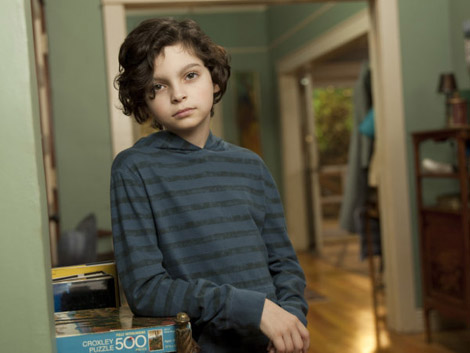 I'm a few days behind on this, but I finally caught up on "Parenthood" and had to ask: Is the storyline of keeping Max's Asperger's diagnosis a secret from him rooted in any type of reality?
Look, I know that it's TV and I forgive the fact that nearly every family drama gets neatly wrapped up in a bow after two episodes (mostly because I like Lauren Graham and her kids so much), but the autism/Asperger's storyline has bugged me from the start.
I have no issue with the portrayal of Max. In fact, I think that the actor who plays him does an amazing job - so amazing, that I had to Google him to make sure he doesn't really have autism. I see bits of Owen in every one of Max's monologues and meltdowns. (Owen even has that shirt Max is wearing.)
But this idea that Max is 8 years old, goes to a school for special needs kids, has a full-time developmental aide and doesn't know that he has Asperger's...I don't get it. It doesn't make logical or even TV sense to me. Do people do that to their kids? And are there 8 year-old Aspies who haven't yet started to ask questions? It's so illogical to me that I'm wondering whether it could possibly be based on an experience that one of the producers has had, because otherwise I can't even figure out why they'd make it up.
I don't want people who aren't familiar with autism to think that it's something we hide from our kids until they accidentally overhear us fighting about it one day.
We told Owen he had autism when he was four or five. I don't know when exactly, because it doesn't stand out as a monumental occasion. We didn't stay up all night explaining it, as it appears they're going to do on "Parenthood" next week. After more than a year of seeing therapists and then starting a more intensive preschool program than his twin brother, it was obvious to him that he was different somehow.
We'd always said, "You just need extra help with some things," and then -- maybe it was around his re-evaluation, where we'd hoped to determine whether he actually had classic autism or if he was in the Asperger's category (he meets the criteria for autism, but seems more functional thana lot of kids I've seen with Asperger's, but that's another topic) -- one day we said, "The reason you need extra help sometimes is that you have autism." We've always said that it just means his brain works a little bit differently. That he's just as smart as Aidan, but he just sometimes has trouble with things that Aidan and other kids don't.
Owen is fine with it. Aidan is fine with it. We talk about it freely, particularly when Owen is having a meltdown. It helps Owen understand why he struggles and it helps Aidan understand why we don't always treat his brother's fits the same as his own.
Actually, Owen is more than fine with it. Sometimes he uses it to elevate himself to special status in comparison with his brother ("Well, I'm the one with autism.") and just a few months ago, he came home from school and announced that he had started an Autism Club with a girl in his class who has Asperger's. I think that's pretty awesome.
I can't imagine why parents would choose to treat it as something to be hidden. A secret that even the person afflicted with it shouldn't know...I just don't get it, and I'm curious if anyone out there can explain it to me? Does this really happen? And do people actually think it's a good idea?
Sunday, December 19, 2010
Downhill
I always kind of brace myself for the emotional kick in the chest that often comes when introducing Owen to new people and experiences. I should be used to it after 4 1/2 years (crazy that it's been that long since he was diagnosed), but expecting it isn't the same as being used to it. It still knocks the wind out of me. I'm writing this while still catching my breath.
We enrolled the boys in snow sports. Aidan's been asking to snowboard since he was 5, so this year we finally signed him up for a local team where he can learn and hang out with other kids and eventually compete if he wants to. He tends to make friends easily and we don't have to worry about whether people know what's on his mind (he never stops talking), so signing him up for activities isn't a source of anxiety for me.
Owen, on the other hand, tends to meltdown when he's scared or frustrated or overwhelmed. Learning new things - physical things - can be really hard for him, so I was a little relieved when he said he wasn't interested in snowboarding. But he surprised us by saying he wanted to learn to ski. We live next to a ski hill, so we signed him up for lessons.
I had a knot in my stomach the whole first lesson, knowing he was up on that hill with strangers and having no idea how he would do. But when I picked him up, he was beaming. He didn't just love it, he felt like he was actually good at it. He told us that he was the best in the class at turning. He talked about it the whole afternoon.
I sent him off again last week feeling great, knowing he was excited and that he was learning to do something that he might actually use the rest of his life. Again, he came back chattering away about how much he liked skiing and how next week they were going to go up the big hill, which would include riding the chairlift! He was so excited.
So when we dropped him off today and the teacher asked us to stay for a minute, I guess I was a little caught off guard. I thought we were in the clear and that somehow, someway, skiing had turned out to be an activity that he could learn and enjoy just like all the other kids.
Alas, Owen's group scooted off to the bunny hill and the head of the program came over with a furrowed brow to tell us that she didn't think Owen was going to be able to stay with his ski group. "He's getting really frustrated," she explained, "and the instructor is having to spend all of her time on him." Bam. That was the kick. She went on to tell us that it could be a real problem to take him on the chairlift, so he might be put with another instructor so he could spend more time on the bunny hill. Kick #2.
Owen, of course, wasn't there to hear this - the adults always talk about these things behind the kids' backs. I know they think it's kinder that way, but all I could think about was how upset he was going to be if all the other kids went off to ride the chairlift and he was suddenly left with a stranger on the bunny hill. He was so excited. He thought he was doing so well.
And now, here I am, feeling once again like it's my fault for trying to pass my kid off as "normal." I feel bad. Because maybe I should have called out that he has autism when we signed him up. But what would they have done with the information? They don't offer special classes for kids with autism - and even if they did, he likely wouldn't fit in there, either, because he's so high functioning. He doesn't qualify for adaptive phys-ed, which means he participates in athletic activities at school right alongside the rest of the kids. He's not physically unable to participate and so far, I haven't found any type of special instruction for kids who are easily frustrated.
Naturally, following that guilt comes the guilt that I should be thankful that he can participate in the first place. That I have the option of sending him off to ski class at all. That he is so high-functioning. That somehow, despite the fact that he's apparently been having meltdowns out on the ski hill, he's still been coming back in with a smile on his face. And of course I am thankful, but I still want him to have the same opportunities as everyone else. If he wants to learn to ski, I want to make that happen. It sounds so simple.
I keep thinking that not everything has to be harder for him. Maybe I'm still in denial. Maybe I just don't know what else to do. Am I being unfair by throwing him into these situations designed for typical kids and hoping that he'll adapt, or am I helping him learn to function in life? I don't know. What I do know is that I'll put up with endless kicks in the chest if it means he can grow up knowing he can do anything he puts his mind to...I'm just hoping that I get the brunt of those kicks and not him.
Sunday, November 7, 2010
You've Got Mail
My boys have email. After initially thinking it was a ridiculous request, we came around and locked them down to their contact list (programmed by us), so it feels pretty harmless. And at least they weren't asking about Facebook accounts.
Sure, they're now learning to use a form a technology that will no doubt be dead by the time they really have people they need to communicate with, but on the plus side, they can practice their correspondence skills (no, I don't think greetings or closings should be cast aside just because we're all in such a damn hurry). Plus, it's fun to get emails from them - especially when I'm traveling, as I was last week for work...
So I got online up in the sky on my way out to Philly (Delta's one redeeming feature) and emailed my children to tell them so...thinking they would find this as amazing as I did. Of course, I also asked about their days at school, told them I miss them, love them, etc.
Owen's response (in its entirety):
"You accidentally spelled the instead of they."
Yep. Nothing says love like proofreading. Email has unlocked his inner grammar robot. I think this might be an overlooked skill set for those with high-functioning autism. Who knew?
And P.S., our kids don't find it amazing that we can email from the sky. They assume we can email from the sky. Welcome to the future.
Saturday, October 23, 2010
Silver Lining
One of the blessings and curses of autism is that the kids who have it tend to be oblivious to what others think of them. I generally tell myself that this is a good thing for Owen, because really, how much of what people think of us actually matters anyway? Yes, of course there's something to be said for self-awareness, but I suppose it makes me feel better to imagine that one day he will emerge unscathed from adolescence, never once doubting who he was or whether he was good enough. As if he is insecurity-proof.
Yeah, well, that illusion was shaken yesterday when we hosted the boys' very first sleepover. A friend from school (Aidan's BFF since kindergarten) and her younger brother, to whom Owen seems to relate pretty well. (Is this common? Kids with high-functioning autism socializing better with younger kids? I don't know.) Both boys were soooooo excited.
But just before their friends arrived, Owen's anticipation proved overwhelming and resulted in a meltdown that found him screaming things along the lines of, "They are more interested in Aidan!" and "They're all going to play without me!" And it hit me that even though he seems pretty much oblivious to social dynamics, he's not. In fact, he's been thinking about being left out and about what people think of him. Thinking, but never expressing these things until now. (Neither of his above statements proved true, by the way - the sleepover was a smashing success.)
So as it turns out, he is not insecurity-proof. I mean, of course he's not...I guess I just wish he was. If he has to struggle with social interactions, it seems only fair that rejection shouldn't bother him.
But, as hard as it is to see him struggling with relationships (already, at age 7), I'd like to think that if he's picking up on the bad, he'll also be able to take in the good...that he will build deep connections in his life and get to enjoy all that comes from finding people who really understand him. I think he will.
Saturday, May 22, 2010
No Thanks
I feel like over the past four years since Owen's diagnosis, I've gone through the fear and anger and all the standard emotions, and I've arrived at a place where it's just part of our lives and usually it doesn't bother me that much. I don't curse autism daily for making my baby's life harder than it needs to be. He's healthy and happy and we're lucky for that.
So I was a little caught off guard this week when we got called into a meeting where the school informed us that even though Owen is smart - really, really smart - they think that his difficulty with expressing himself through writing (and the subsequent meltdowns it causes) will pose too much of a challenge for him to enter into the gifted program next year.
The truth is that we had the same reservations and hadn't even submitted his application to the program until we got his phenomenal test scores back. And yet...having the school tell me that put me on the defensive. It's not fair. His amazing mind is in there working away, but he just can't write a paragraph about it. (Well, he maybe could, but it's hard enough that he doesn't want to and will tell you so.)
And it made me mad, like something was being taken away from him. Like autism is taking something away from him. And I haven't felt that way for a long time.
And then I felt a little bit greedy because I know how lucky we are. Like the me from four years would be telling me to be grateful because it could be so much worse. I should be happy that he is doing so well. I should be happy that we're even talking about the gifted program. And I am.
But should I really feel grateful? Grateful that this mysterious disorder hasn't taken more from him? Like it's some penance and he's getting off easy? No.
I've come a long way, but I'm not ready to thank autism for anything.
Monday, April 12, 2010
In Praise of Smart, Geeky Kids
Dr. Grandin, please find a way to turn your philosophy into an actual school my Owen can attend.
(Thank you, Jill)
Sunday, April 11, 2010
May we all evolve
The other day, Owen had a meltdown. A gigantic meltdown. The kind where his whole body shakes and his fists clench and he screams and cries and he pushes you away and then, seconds later, clings to your neck for dear life.
On the surface, it had something to do with Nerf darts. Underneath, it was his ongoing conflict between the way his brain wants things to be and the way they are.
A lot of parents of kids with autism face these meltdowns daily - hourly, even. We used to struggle with them much more often. Now they happen so infrequently that I am shaken when they occur...I'm caught off guard.
In part, this is because Owen is older and he is very high-functioning. But this is also because we have adapted in the true Darwinian sense. Whereas years ago we made a conscious effort to tell him what to expect before we went places, to give him 5-minute warnings before it was time to change activities, to try to make eye contact and ask him to repeat what we had said to ensure that he was listening...now it's unconscious. It's part of our lives. It's just how things work here.
We have fewer meltdowns because we have evolved our parenting style to head-off things that cause them - and not in a spoiled, this-kid-gets-whatever-he-wants kind of way (honestly, Owen could not have simpler wants), but mainly just through a subtle difference in how we talk to him and how we expect things to go. I suppose all parents do this is some way: you do what works.
I want to be clear here: I am not suggesting that in households where meltdowns are still a regular occurrence, it's because the parents have not suitably adapted their parenting styles. I'm not preaching that we have some superior ability to outsmart the meltdowns that come with autism. I'm saying that we're lucky because we are usually able to avoid the triggers, while I realize that for some kids with autism, unavoidable things like light, clothing, and food can all cause meltdowns.
But anyway, my point is, because we've adapted, Owen's autism doesn't feel like a big deal most days. That doesn't mean we don't notice it - it's just not a daily fight for us. The flip side of this is that whenever I send my little Owen out into the big, unadapted world, I worry.
The worry related to autism are different than the typical mom worry. Or maybe it's a magnified version of the typical mom worry: Will they be safe? Will they be happy?
I worry that people won't understand him. That they will not recognize the signs of an approaching meltdown, or that they wouldn't know what to do even if they did. That they will mistake his meltdown for disobedience. That he will be ostracized or, worse, punished for what is a visceral reaction to being overwhelmed and frustrated.
I have these worries and my son is one of the most high-functioning kids with autism I've had the pleasure to meet, so I cannot imagine the kind of anxiety I would have if this disorder affected him more severely...if communication was an even greater challenge for him.
So, in light of it being Autism Awareness Month, I guess that's near the top of my Autism Wishlist: Give everyone the knowledge and empathy to recognize how hard it can be for people with autism to interact in our neurotypical world.
It's a tall order, yes, but given that it's on my list right under "Find cause" and "Find cure," it feels appropriately aspirational. And maybe achievable on some level. I'm starting with the people in our lives - maybe you can start with the people in yours? Baby steps.
If you want to learn more about autism spectrum disorders, visit www.autismspeaks.org.
Friday, April 2, 2010
Spread some knowledge, spread some love
Happy World Autism Awareness Day!
I’ve written about autism. Many. Many. Many times. It’s part of my everyday life.
With 1 in every 110 children now being diagnosed with an autism spectrum disorder, there’s a good chance that autism is part of your life, too – or that you at least know someone (me?) who is affected.
So how does one celebrate such a day? (Or an entire month, for that matter, since April is Autism Awareness Month.)
Well, if you’ve got a kid on the spectrum, the first thing to do is hug him (or her, but it’s four times more likely to be a him) and remind yourself how lucky you are to have this little (or big) person in your life. (This same process can be followed with typical kids even though it’s not Neurotypical Awareness Day.)
Next, you might want to consider donating to Autism Speaks or another autism-related cause. Your money could go to the brilliant scientists who are going to figure out why our kids’ brains are different and then find a cure. Or, maybe it will go toward making it illegal for insurance companies to discriminate against our kids. There are lots of other worthy efforts around autism that also need funding, but those are the two biggies at the moment.
And, my final recommendation on celebrating World Autism Awareness Day and Autism Awareness Month: Educate yourself and others. Understanding is the key to progress here.
Acceptance is a good start - all of our kids (and we, as their parents) deserve to be treated fairly. But the importance of cultivating understanding goes deeper than acceptance. If everyone understood the disorder better, we could have more support for people on the spectrum, more people working on treatments, and more people funding the research that will ultimately lead to its cause and its cure. It can start with you.
• More children will be diagnosed with autism this year than with AIDS, diabetes and cancer combined.
• No one knows what causes autism and there is no proven link between autism and vaccines.
• Children with autism have trouble relating to other people. This can mean everything from being socially awkward to being unable to speak.
• Even though there is no cure for autism, early intervention with individualized therapies has been proven to treat the symptoms of the disorder, helping kids gain many of the skills they need to learn and become functional adults. Some parents would go so far as to say that their children have actually "recovered" from the disorder. For the majority of people with autism, however, it's something they will deal with their entire lives.
Just in case you need a cheat sheet, here are a few key points you might want to share:
• Autism is a neurological disorder that affects every person differently. It’s called a spectrum disorder because of the wide variance in symptoms and severity among affected individuals.
• Autism is a neurological disorder that affects every person differently. It’s called a spectrum disorder because of the wide variance in symptoms and severity among affected individuals.
• More children will be diagnosed with autism this year than with AIDS, diabetes and cancer combined.
• No one knows what causes autism and there is no proven link between autism and vaccines.
• Children with autism have trouble relating to other people. This can mean everything from being socially awkward to being unable to speak.
• Even though there is no cure for autism, early intervention with individualized therapies has been proven to treat the symptoms of the disorder, helping kids gain many of the skills they need to learn and become functional adults. Some parents would go so far as to say that their children have actually "recovered" from the disorder. For the majority of people with autism, however, it's something they will deal with their entire lives.
That's really just the beginning, but I hope that it gets you (or someone you know) thinking and interested in learning more. In addition to the Autism Speaks site, which has tons of good information, I recommend the book " Ten Things Every Child With Autism Wishes You Knew." I have other recommendations too, but I'll save some of them to last me through the month.
Tuesday, March 9, 2010
In the 'Hood
I'm behind on this, but still wanted to mention it: Parenthood, the show. Did you watch? I DVR'd it (R.I.P. Tivo) and finally watched in on Sunday. I like it.
I know it's contrived (aren't all TV shows contrived?), I know every character is some kind of vague caricature of a stereotype of some kind or another. But...I like it. I think it has potential.
But what I wanted to note specifically was the Asperger's/autism storyline (of course) because even though it wasn't perfect, the scene where the mom tells the dad that their son was diagnosed...it made me cry.
They were able to hit on the rawness of that moment...the emotion, the confusion that I think most people have when they find out. And that struggle between the parents...her trying to make him understand that she needs him to believe it, him saying that he won't let his son be put in special ed...it was familiar. It was hard to watch even a TV couple going through it.
I was impressed that they were able to hit that nerve in me, as I'm the person who could never watch the episodes on ER when they were in the NICU because of the gross oversimplifications and inaccuracies. But with this, so far, I'm in...maybe it's the whole Lauren Graham/Craig T. Nelson combo, not sure.
Yes, so the whole "It's my team" business at the end was fairly unbelievable, but I'm forgiving them that on the promise that they will ultimately help more people understand the sometimes quieter, more subtle, but no less gut-wrenching, struggles of having a child with autism. Don't let me down, NBC.
Thursday, February 18, 2010
The Hindering of Progress
I read this letter by Special Olympics chairman, Timothy Shriver, today.
I've been hearing a lot lately...maybe for the last couple years...about the word "retard." Back when "Tropic Thunder" was released, there was a lot of hub-bub and, I'll be honest, I agreed that it was distasteful, but I also thought that all the protests were lost on the teenage boy demographic, at whom that movie was targeted.
I'll be even more honest and say that I didn't really care about the word until I had a son with autism. I didn't use it, but it didn't make me cringe the way it does now. I fully support Mr. Shriver's position that the word is harmful to the intellectually disabled, but, on a personal level, that's not what made me hate the word.
I hate the word because it's a lazy, hateful embodiment of ignorance that could one day be thrown at my son, who is not even mentally disabled. For that reason alone I feel compelled to eliminate it from the lexicon...because autism and intellectual disability do not go hand in hand. In Owen's case, he might actually be more brilliant because of this disorder.
The thing is, most people I know who use the word don't do so out of hatred. It's just too easy to call people and behaviors you don't understand, "retarded." But really, once you're past, say, 16 and your brain has begun to unscramble, there's just no excuse for such laziness.
So for those of you having trouble ridding your vocabulary of this word, here's my advice:
If you really have a problem with someone, first, make sure the person in question isn't actually mentally disabled. (If they are, and you still want to insult them, you may want to seek professional help.) Second, take a moment to think about what particular characteristic you really want to criticize and then choose your words accordingly. I guarantee that "retard" is not the appropriate word for the occasion, no matter how small-minded you might be feeling.
Together, we can kill the word. And start sounding smarter in the process.
Thursday, December 3, 2009
Knowing (and Not)
The boys finally got their H1N1 vaccines today. I didn't want to deal with crazy lines, so we went through their pediatrician's office. Unfortunately, their pediatrician's office didn't get any of the mist, so I was forced to inform the boys that there would be needles involved.
I think we all still have traumatic memories of their five-year check-ups, at which they both received several immunizations and I discovered (too late) that when I had warned them there would be "shots," they had no idea what that meant.
But this time I figured we'd be prepared, so I gave them a heads up last weekend and have since been met with daily complaints, whines, and questions about why they have to do this. I informed them that sometimes you have to do things that you don't like to stay healthy. I went so far as to explain that while I was in the hospital pregnant with them, I had to get two shots every single day and that I didn't like it, but (and I swear this wasn't intended to be a guilt trip) "I did it because it helped keep you safe in my tummy." Seriously, I spoke those very words maybe two days ago.
So imagine how I felt today when I learned of this research, which says that beta 2 adrenergic agonist drugs might cause autism. More precisely: "Prenatal exposure to continuous high doses of beta 2 adrenergic agonists can permanently dysregulate signaling from the beta 2 adrenergic receptor."
Terbutaline, the drug that was injected into my body twice a day, every day, for 3 and a half weeks while I was pregnant, is one such beta 2 adrenergic agonist drug. Now, I don't usually jump at every article claiming such-and-such may cause autism, but it's not that often that the circumstances being described so closely match ours.
I'd say shock is the most appropriate way to describe how I felt when I read this. Then anger, then sadness. I've said over and over that I want to know why, but I guess I wasn't prepared for the possibility that something so avoidable could be the reason my little boy may face lifelong challenges.
And no, it's not concrete. I can't say with any certainty that this is what it was...that had I not been given those injections I would have two neurotypical children. If anything, I probably lean more in the direction that had I not had those injections, I might not have either of my kids today.
Terbutaline slows contractions almost instantly. Even combined with my IV of magnesium sulfate, it was never able to stop my contractions completely, but it definitely slowed them down and I do believe that slowing down my contractions allowed me to make it as far as I did with them. Had they been born when I was admitted to the hospital at 23 weeks, I don't think they would be alive. And if they were, we would likely be dealing with challenges far greater than high-functioning autism.
But...it's not as if I made an informed choice. I didn't know. Logically, I can't feel guilty about that, but there's something so sad about the idea that there was actually a moment when things could have been different.
Still, if we're talking risk versus reward, I wouldn't risk what I have. If I ever get my time machine, I won't go back to find out whether that drug made the difference between my babies living or dying on the off chance that had they survived, then maybe Owen wouldn't have autism. That's something I can live without knowing.
Wednesday, November 11, 2009
Unwritten
We had parent/teacher conferences on Monday. Interesting thing: they are both doing great in their separate classrooms - excelling in reading and math - but they both need to work on their handwriting.
Aidan's writing is just messy because his brain works faster than his hand, so we need to work on getting him to slow down enough for it to be legible.
Owen, on the other hand, just doesn't want to do it. He hates the act of writing. This seems to be his only major source of meltdowns in the classroom. He can write - it's actually one of the few things he mastered before Aidan did - he just doesn't like it and has been refusing to do it. We think part of it is that he struggles to form his ideas into words, but thanks to this uncannily-timed story from NPR, it turns out that it might also be that the physical act of it is more difficult than we realized.
As a parent of a child with a disorder so confusing and mysterious, I can't tell you how exciting it is to read an article about it and actually go, "That's our situation! That's Owen!" Of course, the story doesn't exactly offer solutions, but even just identifying it as a common issue is helpful (mentally, at least). I am anxious to see if teaching him to type could help him get over the handwriting hurdle and let him focus on learning alongside his peers.
Because seriously, if writing turned out to be his biggest obstacle in school, well...I could deal with that.
Subscribe to:
Posts (Atom)